The Shift From Missions to Presence
Exploration has historically been framed as a sequence of discrete missions. Crews launched, objectives were completed, and equipment returned or was abandoned. A sustained presence changes that logic entirely. Instead of asking how to visit a place, planners must ask how to stay, operate, and recover from failure in an environment where resupply is limited and delays are unavoidable.
Short-Term Objectives Versus Long-Term Systems
Early exploration prioritizes speed and achievement. Long-term presence prioritizes reliability and maintainability. Hardware must be repairable, not just functional. Processes must assume wear, human error, and unexpected conditions.
This difference affects every design choice, from habitat layout to power generation. Systems that work once are insufficient. They must work repeatedly, with predictable performance, under conditions that cannot be fully simulated on Earth.
Changing Risk Tolerance
Exploratory missions accept higher risk in exchange for discovery. Infrastructure-driven programs aim to reduce risk over time. Redundancy, monitoring, and gradual deployment replace single high-stakes events.
This does not eliminate danger, but it changes how it is managed. Risk becomes something to be measured, mitigated, and distributed across systems rather than concentrated in individual missions.
Organizational Continuity
Sustained presence requires institutions that outlast political cycles and individual programs. Knowledge transfer, standardized procedures, and long-term funding commitments become as important as technical capability.
Without organizational continuity, infrastructure degrades quickly. The challenge is not only building systems, but ensuring that future teams can understand, maintain, and improve them.
Learning Through Iteration
Permanent presence does not emerge fully formed. It develops through incremental steps, feedback loops, and adjustment. Early systems will be imperfect, and failure will be part of the learning process.
Designing for iteration allows infrastructure to evolve rather than be replaced. This mindset treats early deployments as foundations, not final solutions.
Habitats as Living Systems
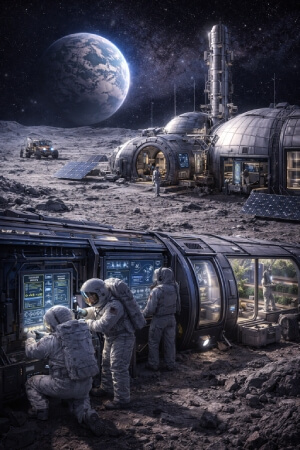
Habitats are often viewed as inert shelters. However, they tend more to be potential organs manipulating the air, water, temperature, and waste in both desired and adverse ways that have an impact on health and productivity. As such, habitats on the Moon, a region where sunlight is far crisper than on Earth, with something of an absence of atmosphere from which one must build ecosystem resilience, must be planned by science that is completely off what any say about an earthly construct. Somehow here with brute engineering limitations, human comforts be weighed; assuredly it is not luxury but feeds productivity, judgment, and long-term survival.
Modularity and Expansion
Early habitats are likely to be small and tightly optimized. Over time, they must expand without disrupting ongoing operations. Modular design allows new sections to be added while older ones remain functional.
This approach also supports experimentation. Different modules can test alternative life-support systems, layouts, or materials, generating data for future designs.
Environmental Control and Life Support
Life-support systems need to run round-the-clock with minimal intervention. Air and water recycling takes a front and center here, as is the need to monitor system health and respond to out-of-the-ordinary readings before any development occurs.
Automation is growing in importance here, but human oversight remains an absolute necessity. Designing some kind of interface displaying acquired critical data in a self-explanatory fashion will certainly make human activities easier to manage.
Psychological and Social Considerations
Long-term habitation introduces psychological challenges that short missions largely avoid. Confinement, monotony, and separation from Earth can affect mental health and group dynamics.
Habitat design can mitigate some of these effects through lighting, private spaces, and flexible work areas. Organizational practices, such as structured routines and communication schedules, are equally important.
Maintenance as a Core Activity
In a permanent outpost, maintenance is not a secondary task. It is central to survival. Habitats must be designed so that critical components are accessible, diagnosable, and repairable with limited tools.
This reality shifts how crews spend their time. Preventive maintenance becomes part of daily life, shaping training and operational planning.
Data Networks and Operational Awareness
The extended presence varies the availability of data. Off-world infrastructure relies on the nervous system of sensors, communication systems, and data processing networks. Without data of good quality, decision making becomes a risky guessing game. On the Moon, distance, terrain, and time lags complicate the functional network of data. The limited bandwidth is another concern.
Monitoring Environmental Conditions
Continuous monitoring of radiation, temperature, and structural integrity is essential. These data streams allow crews to anticipate problems rather than react to failures.
Automated alerts and trend analysis help prioritize attention, ensuring that critical issues are addressed promptly.
Supporting Remote Operations
Many activities will be conducted remotely, either by operators on Earth or by crews managing robotic systems at a distance. Reliable data links are necessary for coordination and control.
Latency and interruptions are unavoidable, so systems must be designed to function safely even when communication is degraded.
Data Integration Across Systems
Infrastructure generates vast amounts of data, but value comes from integration. Linking habitat systems, logistics, and surface operations creates a holistic picture of outpost health.
Integrated data platforms support better planning and reduce the risk of isolated failures going unnoticed.
Cybersecurity and System Integrity
As reliance on digital systems increases, so does vulnerability to errors and interference. Protecting data integrity is essential, even in environments far from Earth.
Security measures must be built into system design, balancing protection with usability.
Logistics Beyond Earth
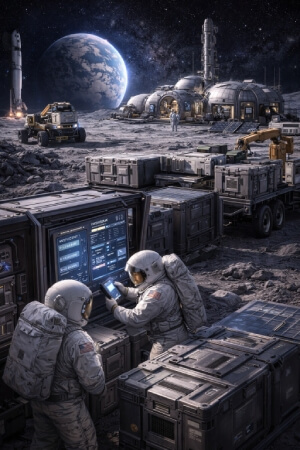
Supply chains on Earth require speed, redundancy, and constant replenishment while logistics in space work around longer lead times, limited launch windows, and high costs per kilogram. Building infrastructure on the Moon would compel a reevaluation of the importance of importing from Earth and what else could instead be produced within that frame.
Reducing Dependence on Earth
Early missions will rely heavily on Earth-based supplies. Over time, this dependence must decrease. Producing basic resources locally, such as water or construction materials, becomes a strategic priority.
Even partial independence can significantly improve resilience. Fewer resupply missions reduce vulnerability to delays and launch failures.
Storage and Inventory Management
Unlike Earth-based facilities, lunar outposts cannot rely on rapid restocking. Inventory must be carefully tracked, and usage rates must be predictable.
Digital inventory systems, combined with sensor-based monitoring, help crews understand what they have and how long it will last. Mistakes in logistics planning can quickly become existential threats.
Transportation and Mobility
Logistics is not only about getting to the Moon, but moving across it. Surface mobility systems enable resource collection, construction, and exploration beyond the immediate habitat area.
Designing vehicles that can operate reliably in dust-filled, low-gravity conditions is a major challenge. Mobility systems must balance robustness with efficiency.
The Moon in the Continuum of Expansion
The moon is often termed as an intermediary object, but it might cause confusion at times. Not just proximity, but also this body's quality as a proving space: with lunar-based systems comes information and data that helps the designs take shape for forthcoming and more distant destinations. Inputting the lunar environment into a bigger array highlights [learning and development] as opposed to its symbolic sense.
Testing Under Real Constraints
Simulations and analog environments on Earth are valuable, but they cannot fully replicate space conditions. Operating on the Moon exposes systems to real constraints, revealing weaknesses that would otherwise remain hidden.
These lessons shape future designs and operational strategies.
Scaling Organizational Models
Indeed, it could be stated that this necessitates close coordination between more than one actor, including governments, research institutions, and commercial entities. The Moon provides a very convenient forum for experimenting with different organizational models.
With growth of activity, thus, comes an enhanced emphasis on well-defined responsibilities, common standards, and conflict-resolution channels.
Ethical and Governance Considerations
Infrastructure implies ownership, responsibility, and impact. Decisions made on the Moon will influence how humanity approaches other celestial bodies.
Establishing norms around resource use, environmental protection, and cooperation sets precedents for future expansion.
Preparing for Greater Distance
Every system deployed on the Moon should be evaluated for how it scales to greater distances. Communication delays, resupply challenges, and autonomy requirements will only intensify farther from Earth.
The Moon offers a chance to adapt gradually rather than confront all challenges at once.
Autonomous and Semi-Autonomous Systems
Autonomous systems amplify capabilities while imposing little or no burden for continual human attention. Robots on the Moon become not just tools, but partners in the construction and upkeep of infrastructure. With autonomy in use, work load is reduced, leaving many operations to continue unaffected during crew absence.
Construction and Assembly
Robotic systems can prepare sites, assemble structures, and perform repetitive tasks. This reduces exposure to hazards and accelerates development.
Early use of autonomy in construction also generates valuable data on system performance in real conditions.
Maintenance and Inspection
Routine inspections can be handled by autonomous or semi-autonomous systems equipped with sensors and imaging tools. These systems detect wear and damage early.
By handling mundane tasks, automation frees human crews to focus on complex problem-solving and research.
Decision Support Rather Than Replacement
Full autonomy is not always desirable. Many systems are designed to support human decision-making rather than replace it. Providing recommendations, simulations, and alerts helps crews make informed choices.
This collaborative model balances efficiency with accountability.
Failure Management
Autonomous systems must be designed to fail safely. When unexpected conditions arise, they should default to states that minimize risk to humans and infrastructure.
Clear handoff between automated and human control is essential in emergency situations.
Laying Foundations Beyond the First Steps
Transformation from exploration to infrastructure is a landmark in human activities beyond the planet. It marks a change in focus moving from isolated achievement to sustained capability, from visiting to living and working. Lunar settlement will not be the end of this but rather a testbed for systems, organizations, and assumptions under real conditions. Thoughtful, realistic, and patient design may thus lay the Foundation for lunar construction, or for construction that may go far beyond a single world.