The Moon as a Scientific Archive
The Moon preserves records that Earth has long since erased. Without weather, flowing water, or active plate tectonics, its surface holds clues about events that shaped the early solar system. Studying these records helps scientists reconstruct periods of cosmic history that are otherwise difficult to observe directly.
Unlike Earth, where geological processes constantly recycle the surface, the Moon offers stability over billions of years. This makes it a natural reference point for understanding planetary formation, impact rates, and long-term environmental change in space.
Preserved Impact History
Craters across the lunar surface document a continuous history of asteroid and comet impacts. Each impact left behind physical evidence that remains largely undisturbed.
By dating these features, researchers can estimate how often large collisions occurred and how they influenced planetary evolution.
This information also helps refine models of impact risk throughout the inner solar system. Understanding past bombardment improves estimates of future hazards to Earth and other bodies.
Clues to Early Solar System Formation
The Moon formed during a violent period when planets were still assembling. Its composition reflects conditions from that era.
Analyzing lunar rocks provides insight into how planetary materials mixed, cooled, and differentiated.
These clues help explain why Earth developed as it did and how common similar processes might be elsewhere. In this sense, the Moon acts as a reference sample from a formative time.
Records of Solar Activity
Particles from the Sun interact directly with the lunar surface. Over time, solar wind ions become embedded in lunar soil.
These particles preserve information about how solar output has changed across vast timescales.
Studying them supports a better understanding of stellar behavior and its effects on planetary environments. This knowledge extends beyond the Moon itself, informing models of habitability elsewhere.
Natural Laboratory for Planetary Science
The Moon’s simplicity makes it a useful test case for theories about planetary processes. Its lack of atmosphere and minimal geological activity reduce variables.
Experiments and observations can be conducted with fewer confounding factors than on Earth.
This clarity allows scientists to validate models that are later applied to more complex worlds. In many ways, the Moon functions as a baseline for comparative planetology.
Historical Significance and Lessons Learned
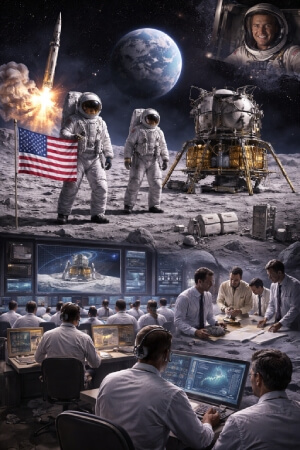
The human interaction with the moon changed the very landscape of science, technology, and global culture. The earliest exploratory adventures unveiled the power of what concerted technological ambition could achieve. It is a result of those missions that influences how space exploration is planned and executed even today.
The Moon was also anything but an easy target for those missions as she was a training ground for systems that have come to be the backbone of both NASA and the planet. The lessons learned during those lunar trips were included in what will serve as astronauts' training for the next missions in some remote planets.
Early Observation and Cultural Meaning
Long before modern science, the Moon guided agriculture, timekeeping, and navigation. Civilizations tracked its phases to organize daily life.
These early observations laid the groundwork for astronomy as a systematic discipline.
Cultural interpretations varied, but the Moon consistently held a central place in human storytelling. This deep connection explains why lunar exploration carried such emotional weight.
The Era of Human Landings
The first human missions to the Moon represented a turning point in technological capability. Landing, operating, and returning safely required unprecedented precision.
These missions demonstrated the feasibility of sustained human activity beyond Earth.
They also generated vast scientific returns. Samples collected during this period remain actively studied decades later, yielding new insights as analytical techniques improve.
Engineering and Operational Knowledge
Operating on the Moon revealed challenges that remain relevant today. Dust behavior, thermal extremes, and radiation exposure tested equipment and crews alike.
Solutions developed then inform current designs for spacecraft and habitats.
Understanding these constraints early helped shape realistic expectations for long-duration missions. The Moon exposed the gap between theoretical planning and operational reality.
International and Institutional Impact
Lunar exploration influenced global cooperation and competition. It reshaped how governments and institutions approached large scientific projects.
The organizational models developed during this period continue to inform complex international research efforts.
The Moon thus played a role not only in science, but also in how large-scale collaboration is managed.
The Moon as a Testing Ground for Exploration
Designers of future technologies for space must have systems that work reliably extraterrestrially and on Earth. One lucky opportunity lies right next to us today: terrestrial testing is relatively feasible on the Moon. Not only is the relatively short distance to the Moon in favor of learning in an iterative process for Earth-bound technologies: it also offers the advantage of carrying out these lunar missions with few obstacles. Lunar tests bridge the gap between simulation work in the laboratory and deep-space deployment. Such testing provides immense proviso that is not available with experimental simulation on Earth.
Surface Operations and Mobility
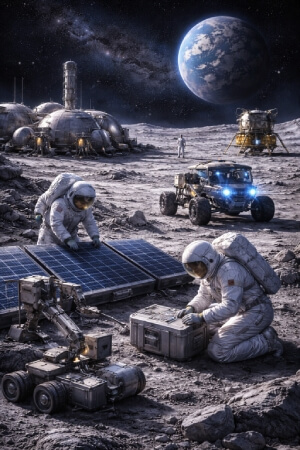
Moving and working on another celestial body presents unique challenges. Reduced gravity affects movement, tool use, and vehicle design.
The Moon allows engineers to study these effects directly.
Developing reliable surface mobility systems improves readiness for operations on other planets. Lessons learned at lunar scale can be adapted elsewhere.
Life Support and Habitation Systems
Sustaining human presence requires closed-loop life support systems. These must manage air, water, and waste efficiently over long periods.
The Moon offers a controlled environment to test such systems with real-world constraints.
Failures and inefficiencies can be identified early. This reduces risk when missions venture farther from Earth, where resupply is impractical.
Power Generation and Storage
Reliable energy is essential for exploration. The Moon’s long day-night cycle challenges conventional power strategies.
Testing solar, battery, and alternative power systems under these conditions provides critical data.
Understanding how systems perform through extreme temperature swings informs designs for deep-space habitats and vehicles.
Robotics and Human–Machine Interaction
Robots play a growing role in exploration. On the Moon, robotic systems can work alongside humans or operate independently.
This environment allows researchers to refine autonomy, teleoperation, and coordination strategies.
Insights gained here support more complex missions, where communication delays and isolation increase operational demands.
Resources and Strategic Considerations
The Moon is not just a place to visit; it may support sustained activity. Its resources and location give it strategic importance for long-term exploration. Understanding these factors shapes decisions about future space infrastructure.
While not a substitute for Earth, the Moon could reduce reliance on constant resupply. This changes how missions are planned and scaled.
In-Situ Resource Utilization
Lunar soil contains materials that can potentially be processed into useful resources. Oxygen bound in minerals is one example.
Extracting such resources reduces the need to transport everything from Earth.
Testing these processes on the Moon helps determine their feasibility. Even partial success could significantly alter mission economics.
Water Ice and Volatiles
Some regions of the Moon are thought to contain water ice trapped in permanently shadowed areas.
Water can support life, generate fuel, and enable extended operations.
Confirming and characterizing these deposits is a major scientific and strategic interest. Their presence would increase the Moon’s practical value.
Orbital and Surface Infrastructure
The Moon’s position makes it a useful waypoint. Infrastructure in lunar orbit or on the surface could support missions farther afield.
This includes communication relays, navigation references, and staging points.
Developing such infrastructure incrementally allows capabilities to grow over time. The Moon provides a manageable environment for this expansion.
Legal and Governance Questions
As interest in lunar activity grows, questions of governance become more pressing.
How resources are used and shared remains an open discussion.
The Moon serves as a testing case for space policy. Decisions made here may set precedents for activity throughout the solar system.
The Moon in a Broader Exploration Strategy
The Moon’s value lies in how it fits into a larger picture. It is neither an end goal nor merely a relic of past achievements. Instead, it connects near-Earth activity with more distant ambitions.
Using the Moon strategically helps manage risk, cost, and complexity. It allows exploration to proceed in stages rather than leaps.
Training and Skill Development
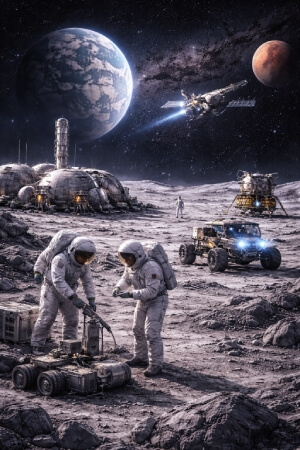
Operating on the Moon develops practical skills that cannot be fully replicated through simulation alone. Crews learn how to manage daily tasks, maintenance, and problem-solving in a reduced-gravity environment where small errors carry serious consequences. At the same time, organizations refine planning, logistics, and emergency response under real constraints. These experiences strengthen both individual and institutional readiness, creating knowledge that transfers directly to longer, more complex missions deeper into space.
Scientific Synergy
Research conducted on the Moon supports a wide range of scientific fields beyond lunar science itself. Findings inform studies of Earth’s geology, planetary formation, and space weather, while also improving models used to interpret data from Mars and other bodies. Because the Moon offers a stable reference environment, results can be compared across disciplines with greater confidence. This interconnected value allows lunar research to amplify scientific understanding well beyond its immediate setting.
Public Engagement and Continuity
The Moon holds a unique place in public imagination, combining familiarity with mystery. Continued exploration sustains interest in space by offering tangible progress that people can easily relate to and follow. This visibility supports long-term commitment to scientific research, education, and exploration infrastructure. A steady lunar presence also reinforces continuity, linking past achievements with future goals and keeping space exploration grounded in shared curiosity rather than short-term spectacle.
Key Roles the Moon Continues to Play
The Moon’s relevance can be summarized through several enduring roles. These functions overlap and reinforce one another, shaping how exploration evolves.
- A preserved scientific record of early solar system history
- A practical testing ground for technologies and operations
- A potential source of resources that support sustained activity
- A strategic location that connects Earth to deeper space
- A cultural and symbolic anchor for human exploration
These roles explain why the Moon continues to attract attention from scientists, engineers, and policymakers alike.
Looking Forward by Looking Back
The defining remains relevant is due to its connection to the entire journey of past, present, and the future. But the ways the Moon comprises ancient history and the carries lessons hard won are manifestations of the power in practical terms for good. As a nearby world that is fundamentally different, it provides clues for us humans to learn to survive and work independently of Mother Earth. When we appreciate the Moon for its intertwined promise, its beauty would perhaps no longer be the terminal destination but the very foundation for what comes next.