Why Humanity Reaches Beyond Earth
The motivation to explore space is often described as curiosity, but it extends far beyond simple interest. Exploration has historically been tied to survival, learning, and the desire to understand unfamiliar environments. Space presents the most extreme unknown humanity has ever faced, pushing both intellectual and physical boundaries.
Looking outward also changes how people see their own world. Observing Earth from space has influenced perspectives on environmental limits, shared responsibility, and global interdependence. In this sense, space exploration is not an escape from Earth’s problems but a lens through which they become clearer.
Curiosity as a Scientific Driver
Curiosity fuels the questions that science seeks to answer. What lies beyond our planet, how celestial bodies form, and whether life could exist elsewhere are questions that have shaped astronomy for centuries. Space exploration turns these abstract questions into testable investigations.
Scientific curiosity leads to missions designed to collect data, observe patterns, and challenge assumptions. Each discovery tends to generate more questions than answers, sustaining a long-term cycle of inquiry rather than offering a final conclusion.
Survival, Resilience, and Long-Term Thinking
Some arguments for space exploration focus on long-term survival. Studying space environments helps researchers understand risks such as radiation, asteroid impacts, and climate processes that also affect Earth. This knowledge supports preparedness rather than speculation.
Planning for the distant future encourages resilience. Space programs often operate on timelines measured in decades, reinforcing habits of patience, continuity, and intergenerational responsibility that are increasingly rare in short-term decision-making.
Cultural Meaning and Collective Identity
Space exploration carries symbolic weight. It often represents what societies believe they can achieve through shared effort and expertise. Even when practical outcomes are uncertain, the act of exploring reinforces values like perseverance and intellectual openness.
These cultural meanings evolve over time. Early space efforts emphasized competition, while modern narratives increasingly stress shared progress and mutual benefit. The shift reflects broader changes in how societies understand cooperation and global challenges.
The Importance of Lunar Exploration
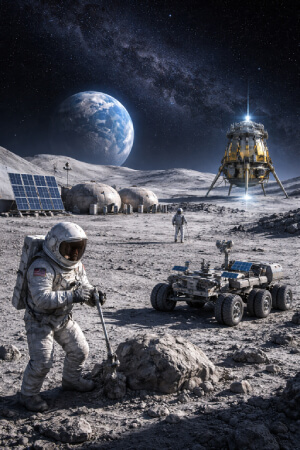
Lunar exploration occupies a unique place in space history and planning. The Moon is close enough to be reachable with existing technology yet distant enough to pose serious challenges. This balance makes it an ideal testing ground for exploration strategies.
Beyond symbolism, lunar missions provide practical opportunities to refine systems, study planetary geology, and develop sustainable operational models. The lessons learned there influence how future missions are designed and managed.
A Nearby Laboratory for Science
The Moon offers a stable environment for scientific study. Its surface preserves geological records that have been erased on Earth by weather and tectonic activity. These records help scientists understand early planetary history and broader cosmic processes.
Studying lunar materials also improves knowledge about resource distribution and surface conditions. This information supports not only scientific goals but also engineering decisions about equipment durability and mission design.
Testing Human and Robotic Systems
Operating on the Moon allows engineers to test life-support systems, habitats, and robotics in conditions that cannot be fully simulated on Earth. These tests reveal weaknesses and design limitations that might otherwise go unnoticed.
Robotic missions play a complementary role. They extend human capabilities, reduce risk, and allow continuous experimentation. The balance between human presence and automation remains a central question in exploration planning.
Building Operational Experience
Sustained lunar activity requires logistics, maintenance, and coordination over long periods. Developing these capabilities creates experience that transfers to more distant missions.
This operational focus shifts exploration from isolated achievements to ongoing presence. It emphasizes reliability, adaptability, and incremental improvement rather than dramatic one-time events.
Technology as the Engine of Exploration
The exploration of space proceeds arm in arm with progress in technology. Whatever materials, computing, propulsion, and energy systems can afford, one can always expect more. Each generation sees new tools that also further reshape mission objectives or constraints. Technology advances decrease the degree of uncertainty. Better sensors, simulations, and communication systems allow planners to foresee and handle problems in a much more efficient manner if and when conditions change.
Propulsion and Transportation Systems
Reaching space requires overcoming Earth’s gravity, making propulsion a central challenge. Advances in propulsion efficiency affect mission cost, duration, and feasibility.
Transportation systems are increasingly designed for reuse and adaptability. These priorities reflect a shift from experimental exploration toward more sustainable and repeatable operations.
Data, Automation, and Decision Support
Modern missions rely heavily on data collection and automated analysis. Spacecraft generate vast amounts of information that must be processed, interpreted, and acted upon with minimal delay.
Automation supports this process by handling routine tasks and monitoring system health. Human decision-makers remain essential, but their role increasingly focuses on interpretation and strategy rather than manual control.
Materials and Environmental Protection
Space environments expose equipment and humans to radiation, extreme temperatures, and vacuum conditions. Advances in materials science help mitigate these risks through shielding, insulation, and structural design.
Protecting both technology and human health remains a constant challenge. Solutions developed for space often influence protective technologies in other extreme environments on Earth.
International Cooperation and Shared Infrastructure
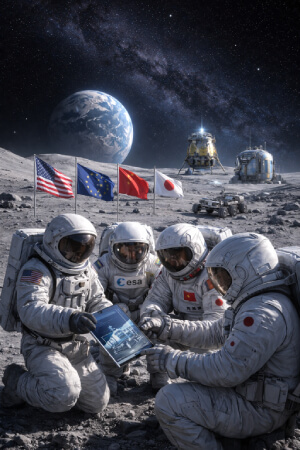
Space exploration has gradually shifted from national competition to international collaboration. Large-scale missions now often involve multiple countries contributing expertise, funding, and infrastructure.
This cooperative approach reflects practical necessity as well as political choice. Complex missions benefit from distributed responsibility and shared risk.
From Competition to Collaboration
Early space efforts were shaped by rivalry and symbolic milestones. Over time, the costs and complexity of missions encouraged collaboration as a more sustainable model.
Collaboration allows participants to specialize, focusing on their strengths while relying on partners for complementary capabilities. This division of labor improves efficiency and resilience.
Standards, Coordination, and Governance
Shared missions require common standards for communication, safety, and data handling. Developing these standards involves negotiation and compromise but yields long-term benefits.
Governance frameworks help manage expectations and responsibilities. While not eliminating conflict, they provide mechanisms for resolving disputes and aligning objectives.
Science as a Neutral Ground
Scientific goals often serve as neutral territory where cooperation is easier. Shared data and joint research projects build trust and mutual understanding.
This scientific diplomacy does not replace political considerations, but it can soften tensions and create channels for dialogue that extend beyond space programs.
Economic and Educational Impacts
Space exploration contributes significantly to economies and education systems although the influence is discreet. It supports specialized industries and high-skilled employment. These impacts take a long time to occur, depending on how technologies and expertise get nurtured and applied in other fields.
Innovation and Technology Transfer
Technologies developed for space often find applications elsewhere. Advances in imaging, communication, and materials contribute to broader technological ecosystems.
The process of adapting space technology for everyday use requires additional effort, but the underlying research creates a foundation for innovation across industries.
Workforce Development and Skills
Space programs demand a wide range of skills, from engineering and science to project management and systems integration. Training for these roles strengthens educational institutions and professional networks.
Exposure to space-related careers also influences younger generations. Educational programs linked to space exploration encourage interest in science and engineering fields.
Economic Scale and Public Investment
Public funding plays a central role in space exploration. These investments reflect choices about long-term priorities rather than short-term returns.
Evaluating their value requires a broad perspective that includes scientific knowledge, infrastructure development, and societal inspiration.
Ethical and Environmental Considerations

As activity in space increases, ethical and environmental questions become more pressing. Decisions made now will shape how space is used and protected in the future.
These considerations extend beyond technology. They involve values, responsibility, and the recognition that space is a shared domain.
Planetary Protection and Responsibility
Avoiding contamination of other celestial bodies is a key ethical concern. Protecting potential scientific evidence and respecting unknown environments guide mission design.
Responsibility also includes preventing harm to Earth. Managing debris and minimizing environmental impact are ongoing challenges that require collective action.
Equitable Access and Participation
Access to space capabilities is unevenly distributed. Ensuring that exploration benefits are shared rather than concentrated raises complex policy questions.
Equitable participation does not imply uniform involvement, but it does encourage transparency and inclusive decision-making.
Long-Term Stewardship of Space
Space is often described as vast, but usable orbits and stable environments are limited. Stewardship involves managing these shared resources carefully.
Long-term thinking emphasizes preservation alongside exploration, balancing ambition with restraint.
Key Themes in Modern Space Exploration
In the present discussions on space, distinct themes recur. In that respect, these themes combine technical judgments with social and ethical opinions, influencing how exploration progresses.
Within the set, they may guide our understanding of not only what is now done but also what ought to be done:
- The broad contours of how long exploration may take and how it could be some unending process
- Reliance and sustainability for technology for conservancies and adaptability
- International cooperation as necessity and political choice
- Ethical responsibilities for the places beyond Earth and for posterity
- An educational and knowledge-sharing perspective is the real fruition of human discovery
The themes foreground a turn away from symbolic milestones to long-term involvement. This suggests that exploration is determined to a greater extent by changing social systems.
Another option would be challenging circumstances fraught with conflict and opportunism. Innocuous scientific processes would not totally protect the scientist, strengthen shared norms and frameworks of governance in and between states, and give non-state actors a foothold in the shaping of global policies and frameworks.
Looking Forward Without a Finish Line
Space exploration does not have a clear endpoint. Each achievement redefines what is considered possible, expanding expectations and responsibilities. This open-ended nature distinguishes it from projects with fixed goals.
Looking forward requires balancing ambition with caution. The pace of exploration will likely vary, shaped by technological readiness, political will, and societal priorities.
Incremental Progress Over Grand Gestures
Future space exploration is increasingly shaped by patience rather than spectacle. Instead of focusing on singular milestones, programs prioritize continuity, reliability, and learning over time. Infrastructure development, system refinement, and operational experience create a foundation that can support many missions rather than one defining moment. This steady approach improves resilience by allowing setbacks to be absorbed without halting progress. It also encourages adaptability, making room for new knowledge, improved technology, and evolving goals.
Public Understanding and Support
Long-term exploration depends on sustained public trust, which is built through clarity rather than excitement alone. When goals, risks, and limitations are explained openly, space programs are easier to evaluate and support. Public engagement works best when people are treated as informed stakeholders, not distant spectators. Education, transparency, and realistic expectations help align exploration efforts with societal values, ensuring that support is based on understanding rather than temporary enthusiasm.
Exploration as Reflection
Space exploration reveals as much about humanity as it does about the universe. The missions pursued, the risks accepted, and the resources committed reflect collective priorities and beliefs about progress. Choices made in space often mirror how societies balance ambition with responsibility. In this way, exploration functions as both outward expansion and inward examination, offering insight into how humans define purpose, cooperation, and their relationship with the unknown.
The View from Farther Away
Over time, the quest for knowledge by humans kept on broadening as they moved past Earth boundaries. This search of cosmic grounds brought science, technology, and imagination together in the pursuit of it all. Questions are more important than answers. It is from this standpoint that the importance of living for questions and not for answers begins to show its track. This endless quest for exploration may become the most certain lesson: curiosity, cooperation, and responsibility are one if they will be able to conquer unknown things.