Engineers: Turning Ideas Into Reliable Systems
Engineering work is, at its core, the structural basis of all space missions. Even before it takes off, engineers must transform abstract goals and objectives into physical systems that are capable of surviving the forces and rigors of launch, while standing up against radiation and temperature extremes, and successfully accomplishing tasks over vast stretches of time with little human intervention.
Systems Engineering and Integration
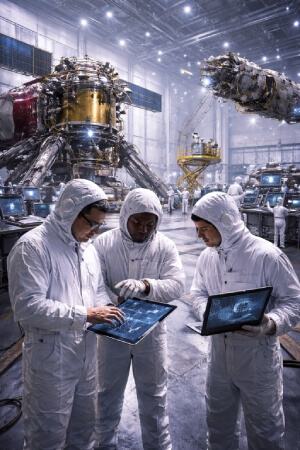
Systems engineers focus on how individual components interact as a whole. They coordinate between propulsion, power, communications, thermal control, and software teams to ensure that changes in one area do not create failures elsewhere. This integration work is essential because space systems cannot rely on improvisation once deployed.
Their decisions often involve tradeoffs rather than perfect solutions. Increasing redundancy may add weight, while simplifying designs can reduce flexibility. Systems engineers help teams understand these consequences and choose paths that align with mission priorities.
Mechanical and Structural Design
Mechanical engineers design structures that have to be light enough to take off but strong enough to survive the separation and boost into space followed by high vibration and high acceleration for the first few minutes thereof.
These engineers spend more time defining models, conducting tests, conducting flight tests, and building manufacturing plans to avoid problem zones in the field.
Electrical and Software Engineering
Electrical and software engineers ensure that spacecraft can think, communicate, and respond. Power systems must operate efficiently over years, while onboard software handles everything from navigation to fault detection. Because software updates may be limited or delayed, reliability and clarity matter as much as innovation.
Together, these disciplines ensure that spacecraft can operate autonomously when direct human control is impossible.
Scientists and Researchers: Defining the Questions
Scientific contributors shape why missions exist in the first place. They identify unanswered questions, define measurements, and help determine what data is worth collecting. Their work ensures that missions return knowledge rather than just technical demonstrations.
Planetary and Space Scientists
In order to understand the aforementioned aspects of planetary bodies, planetary scientists are mandated to study their composition, history, and suitability to support life. Keeping them front and center to the mission planning in turn consents to their input guiding the selection of instruments and trajectory of the mission. It is often the case where decisions on locations to land, samples to collect, or regions to observe stem from their research priorities.
Similarly, observations of scientists in space, such as of those in the astrophysics field or in heliophysics, define the observation strategies and data needs influencing the design of missions.
Earth and Climate Researchers
Some space missions focus on observing Earth itself. Climate researchers and Earth scientists use satellite data to study weather patterns, ocean circulation, land use, and atmospheric composition. Their needs shape sensor resolution, coverage, and calibration methods.
Long-term data consistency is especially important in this area, making collaboration between researchers and engineers critical.
Data Interpretation and Validation
Collecting data is only the beginning. Researchers validate measurements, correct errors, and interpret results within broader scientific frameworks. Their work often continues long after a mission’s active phase ends, extending the value of space exploration over decades.
Mission Planners and Operators: Managing Complexity Over Time
Once a mission is approved, planners and operators guide it from concept to execution and beyond. Their work blends technical understanding with coordination, scheduling, and decision-making under uncertainty.
Trajectory and Timeline Planning
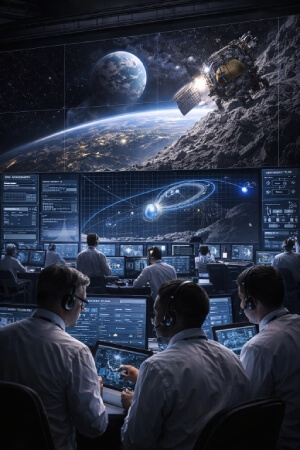
Mission planners calculate launch windows, orbital paths, and encounter sequences. These choices depend on celestial mechanics, fuel limits, and mission goals. Small changes early in planning can have large effects years later.
They also design timelines that balance scientific objectives with system constraints, ensuring that spacecraft resources are used efficiently.
Operations and Real-Time Decision Making
During operations, teams monitor spacecraft health, respond to anomalies, and adjust plans as conditions change. Even with automation, human oversight remains essential, particularly during critical phases such as landings or close flybys.
Operators must remain calm and methodical, often working long hours during key mission events. Their experience helps transform unexpected situations into manageable challenges.
Risk Assessment and Contingency Planning
Mission planners devote significant effort to preparing for what might go wrong. They develop contingency procedures and decision trees that guide responses to failures. This preparation allows teams to act quickly and consistently when anomalies occur.
Interdisciplinary Teams and Collaboration
Without collaboration across disciplines, the operations of modern space voyages, including those executed by engineers, scientists, planners, and analysts, would be difficult. Professionals in these areas must tie themselves to one another in order to mutually communicate the conditions and constraints that are in play. In fact, the entire cooperation structure is not random but is created out of necessity.
Communication Across Specialties
Different disciplines often use different terminology and assumptions. Effective teams invest time in clarifying meanings and expectations. This effort prevents small misunderstandings from becoming costly errors later in the mission.
Clear documentation and open discussion support trust and accountability across teams.
Decision-Making Structures
Large missions use defined decision hierarchies to balance inclusivity with efficiency. While many voices contribute analysis, final decisions often rest with designated leads. This structure helps resolve disagreements without delaying progress indefinitely.
Respect for expertise and transparency in reasoning strengthen these decision processes.
Global and Cross-Cultural Collaboration
Many missions involve international partners. Engineers and scientists from different countries bring diverse perspectives and expertise. Managing time zones, cultural expectations, and organizational norms adds complexity but also enriches problem-solving.
Shared goals and clear interfaces help maintain alignment across borders.
Key Roles at a Glance
The following roles show the diverse expertise available when dealing with a single mission context. They may have various responsibilities, but each of them brings its perspective to achieving common objectives.
- Components engineers for coordinating interactions between components
- Mechanical and electrical engineers designing hardware
- Software engineers for developing autonomous control
- Scientists for setting research objectives and data needs
- Mission planners for computing trajectories and timelines
- Operations teams for monitoring spacecraft health
- Data analysts conducting the validation and interpretation of results
- Human factors staff on reporting long-term performances
These roles are never really isolated as regards value and so arise out of such mutual interactions, creative understanding and innovative growth over the other's number in spite of any specific skills alone.
Human Factors and Long-Duration Missions
As missions extend farther and last longer, human considerations become increasingly important. This applies not only to astronauts but also to ground teams who support missions over many years.
Cognitive Load and Team Resilience
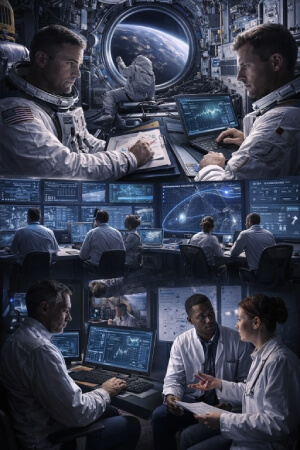
Long-duration missions place sustained demands on attention and decision-making. Teams design workflows that reduce cognitive overload and encourage rest and rotation. Maintaining performance over time requires acknowledging human limits rather than ignoring them.
Resilience planning includes training for rare but high-impact scenarios, helping teams remain effective under pressure.
Ethical and Responsibility Considerations
Choices made during mission design and operations can have long-lasting consequences beyond a single project. Contributors must account for planetary protection, preventing biological contamination, and preserving environments for future study. Responsible management of orbital space is equally important, as congestion and debris affect all operators. Data integrity also carries ethical weight, since scientific conclusions and policy decisions may rely on mission findings. Ethical review processes help teams evaluate these responsibilities before irreversible actions are taken. Increasingly, these discussions involve engineers, scientists, legal advisors, and policy experts, reflecting how space activity now intersects with environmental, scientific, and societal concerns.
Learning From Past Missions
Every mission, whether successful or not, generates valuable lessons. Post-mission reviews provide structured opportunities to examine decisions, technical performance, and team dynamics. By documenting both achievements and failures, organizations create reference points for future projects. This knowledge transfer reduces the risk of repeating mistakes and supports more informed planning. Lessons learned are shared through reports, training, and mentorship, becoming part of institutional memory. Over time, this cumulative learning strengthens problem-solving capacity and helps teams approach new missions with greater confidence, realism, and respect for the complexity of space exploration.
Culture of Problem Solving and Adaptation
Space exploration, by its nature, demands a culture wherein uncertainty is accepted and change is managed. Participants are trained to question assumptions, test scenarios, and revise plans accordingly if the evidence discards the initial assumption. This ability both upholds safety and fosters discovery.
Balancing Innovation and Reliability
Innovation is essential for advancing space exploration, but reliability remains the foundation of mission success. Teams must constantly weigh the promise of new technologies against the risks they introduce. This balance is rarely resolved through dramatic changes. Instead, it emerges through careful testing, simulation, and phased implementation. Novel ideas are often introduced alongside proven systems, allowing performance to be evaluated without jeopardizing mission safety. Reviews, redundancy, and incremental upgrades help teams manage uncertainty. By treating innovation as a controlled process rather than a gamble, contributors ensure that progress does not compromise the long-term viability of complex space missions.
Shared Ownership of Outcomes
Space missions succeed when responsibility is distributed rather than concentrated. Shared ownership means that teams view outcomes, both positive and negative, as collective results of interconnected decisions. This perspective encourages openness, since identifying problems early is valued more than assigning blame. Engineers, scientists, and operators are more likely to support one another when success is framed as mutual. Shared ownership also strengthens accountability, as contributors understand how their work affects others. Over time, this culture builds trust and resilience, enabling teams to respond more effectively to unexpected challenges and maintain focus on mission-wide objectives.
Preparing the Next Generation
Long-term space exploration depends on knowledge transfer between generations of contributors. Experienced professionals mentor newer team members, sharing practical insights that cannot be captured fully in documentation. This guidance includes how to make decisions under uncertainty, how to communicate across disciplines, and how to recognize early warning signs of system issues. Mentorship also reinforces values such as caution, collaboration, and ethical responsibility.
Looking Beyond the Launch
Launching a spacecraft into space is the beginning, a result of years' worth of collaboration by human civilizations. Every outcome is determined by engineers, scientists, program managers, and cross-disciplinary teams who diligently weigh alternatives and assume shared responsibility.